UART Performance Testing
This page measures the transmit/receive rate of the LibXR UART driver at 2–9 Mbaud and the thread scheduling during transfer. The data are earlier measurements and apply only to the STM32F103C8, CH32V307VC, and STM32F407IG setups listed below; the test code below has been updated for the current LibXR, and the data were not remeasured.
Test Environment
The UART driver is one of the most complex parts of LibXR. The testing environment is as follows:
- STM32F103C8, Cortex-M3 @ 72MHz
- CH32V307VC, RISC-V @ 144MHz
- STM32F407IG, Cortex-M4 @ 168MHz
- In Debug mode, only user code is compiled with
-Ogoptimization; HAL, FreeRTOS, USB, and other libraries use-O2. In Release mode, all are optimized with-O3. - The TX and RX pins of USART1 are connected with jumper wires; data bits: 8, stop bit: 1, no flow control, no parity.
- After receiving data, each entire packet is checked with CRC. Every second, the number of successful transmissions, failed transmissions, and total CRC errors is counted.
Test Code
Synchronous transmission and reception each use a separate thread. Although context switching introduces some performance overhead, the impact is minimal. For maximum performance, asynchronous transmission and reception can be used.
  constexpr size_t BUFFER_SIZE = 32;
  constexpr size_t BAUDRATE = 2000000;

  static uint8_t read_buffer[BUFFER_SIZE], write_buffer[BUFFER_SIZE];
  static uint32_t count_read = 0, count_write = 0, count_error = 0;

  for (uint32_t i = 0; i < sizeof(write_buffer); i++) {
    write_buffer[i] = i;
  }

  STDIO::write_ = uart_cdc.write_port_;

  void (*fun)(void *) = [](void *) {
    LibXR::STDIO::Printf<"read count: %u, write count: %u, error count: %u\r\n">(
        count_read, count_write, count_error);
    LibXR::STDIO::Printf<"speed: %u BAUD\r\n">(
        static_cast<unsigned>(count_read * 10 * sizeof(write_buffer)));
    count_read = 0;
    count_write = 0;
  };

  auto print_task =
      LibXR::Timer::CreateTask(fun, reinterpret_cast<void *>(0), 1000);
  LibXR::Timer::Add(print_task);
  LibXR::Timer::Start(print_task);

  void (*thread_read)(LibXR::UART *) = [](LibXR::UART *uart) {
    LibXR::Semaphore sem(0);
    LibXR::ReadOperation op(sem);
    while (true) {
      uart->Read(read_buffer, op);
      if (LibXR::CRC8::Verify(read_buffer, sizeof(read_buffer))) {
        count_read++;
      } else {
        count_error++;
      }
    }
  };

  void (*thread_write)(LibXR::UART *) = [](LibXR::UART *uart) {
    LibXR::Semaphore sem(0);
    LibXR::WriteOperation op(sem);

    uart->SetConfig({BAUDRATE, LibXR::UART::Parity::NO_PARITY, 8, 1});

    while (true) {
      write_buffer[0]++;
      write_buffer[sizeof(write_buffer) - 1] = LibXR::CRC8::Calculate(
          write_buffer, sizeof(write_buffer) - sizeof(uint8_t));

      uart->Write(write_buffer, op);
      count_write++;
    }
  };

  LibXR::Thread read_thread, write_thread;

  read_thread.Create(reinterpret_cast<LibXR::UART *>(&usart1), thread_read,
                     "read_thread", 2048,
                     static_cast<LibXR::Thread::Priority>(4));

  write_thread.Create(reinterpret_cast<LibXR::UART *>(&usart1), thread_write,
                      "write_thread", 2048,
                      static_cast<LibXR::Thread::Priority>(3));

  while (true) {
    LibXR::Thread::Sleep(UINT32_MAX);
  }
Speed Test Results
STM32F1, -Og, 32-byte packets, 2M baud
32 bytes is close to the actual size of a typical UART data packet. At a baud rate of 2 Mbps, this configuration can approach the theoretical maximum throughput of the serial port.
read count: 6000, write count: 5999, error count: 0
speed: 1920000 BAUD
read count: 6000, write count: 6000, error count: 0
speed: 1920000 BAUD
read count: 5999, write count: 6000, error count: 0
speed: 1919680 BAUD
read count: 6000, write count: 5999, error count: 0
speed: 1920000 BAUD
read count: 6000, write count: 6000, error count: 0
speed: 1920000 BAUD
read count: 5999, write count: 6000, error count: 0
speed: 1919680 BAUD
STM32F1, -O3, 32-byte packets, 2M baud
There is no significant difference under O3 optimization.
read count: 6000, write count: 5999, error count: 0
speed: 1920000 BAUD
read count: 5999, write count: 6000, error count: 0
speed: 1919680 BAUD
read count: 6000, write count: 6000, error count: 0
speed: 1920000 BAUD
read count: 6000, write count: 5999, error count: 0
speed: 1920000 BAUD
read count: 5999, write count: 6000, error count: 0
speed: 1919680 BAUD
read count: 6000, write count: 6000, error count: 0
speed: 1920000 BAUD
STM32F1, -Og, 128-byte packets, 4M baud
Larger data packets and higher baud rate.
read count: 3061, write count: 3061, error count: 0
speed: 3918080 BAUD
read count: 3062, write count: 3062, error count: 0
speed: 3919360 BAUD
read count: 3062, write count: 3062, error count: 0
speed: 3919360 BAUD
read count: 3061, write count: 3061, error count: 0
speed: 3918080 BAUD
read count: 3062, write count: 3062, error count: 0
speed: 3919360 BAUD
read count: 3063, write count: 3062, error count: 0
speed: 3920640 BAUD
CH32V307, -Og, 64-byte packets, 9M baud
At a baud rate of 9 Mbps, the theoretical maximum throughput can still be achieved.
read count: 14000, write count: 14000, error count: 0
speed: 8960000 BAUD
read count: 14000, write count: 14000, error count: 0
speed: 8960000 BAUD
read count: 14000, write count: 14000, error count: 0
speed: 8960000 BAUD
read count: 14000, write count: 14000, error count: 0
speed: 8960000 BAUD
read count: 14000, write count: 14000, error count: 0
speed: 8960000 BAUD
read count: 14000, write count: 14000, error count: 0
speed: 8960000 BAUD
System Call Analysis
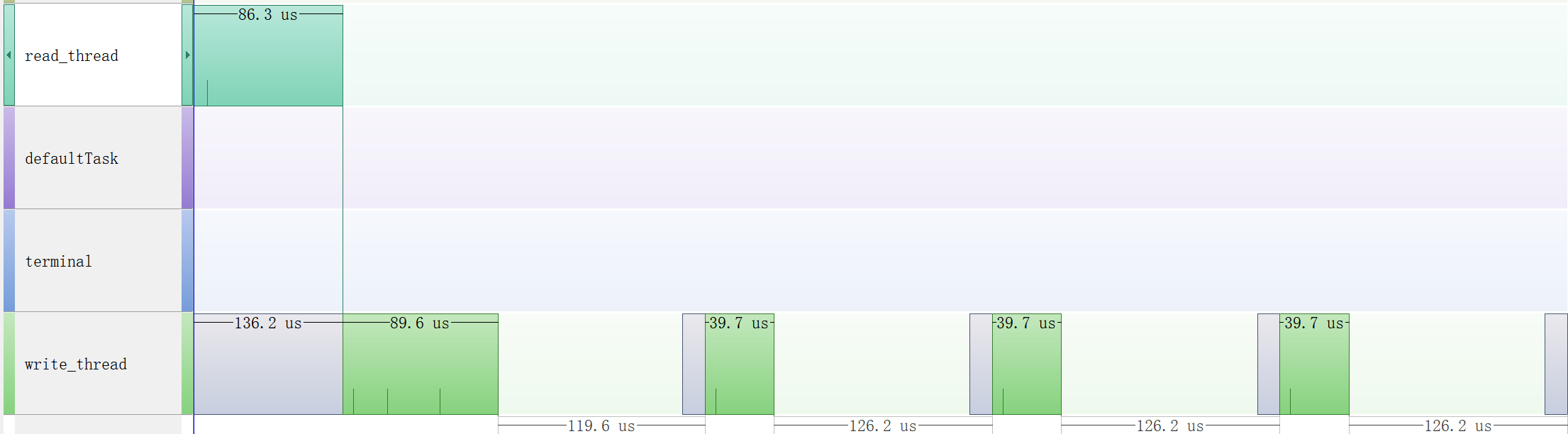
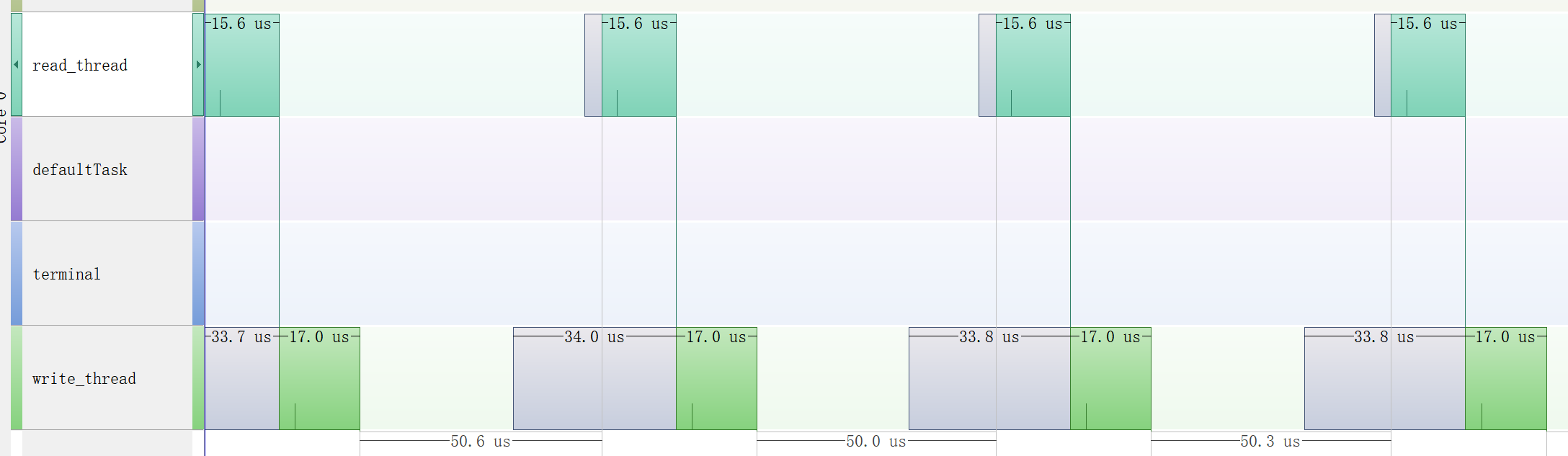
The following uses STM32F4 and SystemView to show the system calls during transmission and reception. The only system calls are the semaphore operations for thread wakeup and synchronization.
Lower Baud Rates
At lower baud rates, multiple packets are concatenated together, making it impossible to trigger the IDLE interrupt. The write thread is periodically woken up, while the read thread is woken up only when the buffer is half or fully filled by an interrupt.
Higher Baud Rates
At higher baud rates, the transmit and receive threads are alternately woken up.
Summary
On STM32F103 (72 MHz), 32-byte packets at 2 Mbaud and 128-byte packets at 4 Mbaud reach a line rate close to the configured baud rate with no CRC errors; CH32V307 (144 MHz) at 9 Mbaud also stays close to the configured rate.